If you picture Haight-Ashbury as a time capsule, today’s reality may surprise you. This part of San Francisco still carries its famous identity, but it also works as a lived-in neighborhood where people run errands on foot, commute by transit, spend time in the park, and come home to some of the city’s most recognizable historic housing. If you are wondering what daily life here actually feels like now, this guide will walk you through the streets, rhythms, housing, and market context that shape the neighborhood today. Let’s dive in.
Haight-Ashbury Today at a Glance
Haight-Ashbury functions as several things at once. San Francisco Planning describes it as a diverse residential neighborhood, a thriving commercial corridor, and an international tourist destination, which is a useful way to understand its layered character.
That combination is what makes the neighborhood distinct. You get a strong local routine alongside steady visitor activity, with Victorian homes, mixed-use buildings, restaurants, boutiques, and parks all packed into a highly walkable area.
What the Neighborhood Feels Like
Upper Haight is the busiest stretch
The Haight Street corridor between Stanyan and Central is the neighborhood’s most active spine. San Francisco’s planning code identifies this area as the Haight Street Neighborhood Commercial District, serving local residents as well as park visitors, with eating, drinking, entertainment, and housing all contributing to its mixed character.
In practical terms, this is the part of the neighborhood where you feel the most street energy. Shops, restaurants, and specialty storefronts line the corridor, and the pace tends to feel lively throughout the day.
The park edge feels more residential
Blocks near the Panhandle and Golden Gate Park often read as calmer and more park-oriented. The Panhandle is closely tied to Haight-Ashbury’s identity, and its long green stretch creates a buffer that softens the neighborhood’s busier retail core.
If you value easy outdoor access, this edge can feel especially appealing. You are still close to Haight Street, but your daily experience may include more dog walks, bike rides, and park time built into the rhythm of the day.
Lower edges bring a different mood
As you move downhill toward Lower Haight, the atmosphere shifts. Local guides describe that transition area as having more dive bars, consignment stores, and record shops, giving it a more nightlife-oriented feel than the central retail corridor.
That means Haight-Ashbury is not one-note. Even within a relatively compact area, the experience can change from block to block depending on your proximity to the commercial strip, park space, and adjoining neighborhood edges.
Walkability and Getting Around
A walk-first neighborhood
Haight-Ashbury scores exceptionally well for day-to-day convenience. Walk Score gives the neighborhood a 97 Walk Score, along with a 73 Transit Score and 82 Bike Score, and notes about 48 restaurants, bars, and coffee shops in the area.
For many residents, that supports a true walk-first lifestyle. Coffee runs, meals out, quick errands, and casual browsing can all happen without needing to get in a car.
Transit options are strong
SFMTA lists a broad mix of transit service in and around the neighborhood, including the F Market & Wharves, N Judah, N Judah Bus, 1 California, 5/5R Fulton, 6 Hayes/Parnassus, 7 Haight/Noriega, 24 Divisadero, 33 Ashbury/18th Street, 37 Corbett, 43 Masonic, and 66 Quintara lines.
That range gives you flexibility if you commute to other parts of San Francisco or simply want options for moving around the city. Transit-rich neighborhoods often feel easier to live in over time, especially when combined with strong walkability.
Driving is possible, but not the main story
Haight-Ashbury is much more about walking, biking, and transit than it is about driving convenience. Still, for residents who keep a car, SFMTA lists the Kezar Lot at 825 Stanyan as a 24/7 lot.
That does not make the neighborhood car-centric, but it adds one practical option. For many buyers and renters, the bigger takeaway is that you can often build a lifestyle here that depends less on driving in the first place.
Parks and Outdoor Routine
The Panhandle shapes daily life
The Panhandle is one of the neighborhood’s defining assets. San Francisco Recreation and Park describes it as a three-quarters-of-a-mile-long, one-block-wide park with walking and biking trails, a playground, basketball courts, restrooms, and a direct connection to Golden Gate Park.
That kind of open space changes how a neighborhood lives. It gives residents a place to exercise, meet friends, take children to play, or simply break up the day with a short walk under trees.
Golden Gate Park is part of the lifestyle
Because the Panhandle connects directly to Golden Gate Park, outdoor access here extends well beyond a single green strip. Living near Haight-Ashbury can mean having one of San Francisco’s major recreational assets function as part of your regular routine.
For buyers thinking about long-term livability, that connection matters. It supports both convenience and quality of life in a dense urban setting.
Shops, Cafes, and Everyday Errands
The retail mix is still eclectic
One of Haight-Ashbury’s biggest draws is its unusually varied merchant mix. The Haight Ashbury Merchants Association directory includes well-known local names like Amoeba Music, Booksmith, Woot Bear, San Francisco Mercantile, Love on Haight, Ritual Coffee, Pork Store Café, Blue Front Café, and Roberts Hardware, alongside many vintage and specialty shops.
That mix gives the neighborhood texture. You are not looking at a uniform retail corridor. Instead, the street supports a blend of practical stops, independent businesses, and destination shopping.
Daily life happens on foot
A useful way to think about Haight-Ashbury is as a neighborhood built around foot traffic. Brunch, coffee, music shopping, browsing, vintage hunting, and everyday errands can all happen on the same short stretch of street.
That creates a street life that feels active without needing a major plan. You can head out for one quick errand and end up spending an hour or two moving through the neighborhood.
Housing Style and Architecture
Historic homes define the area
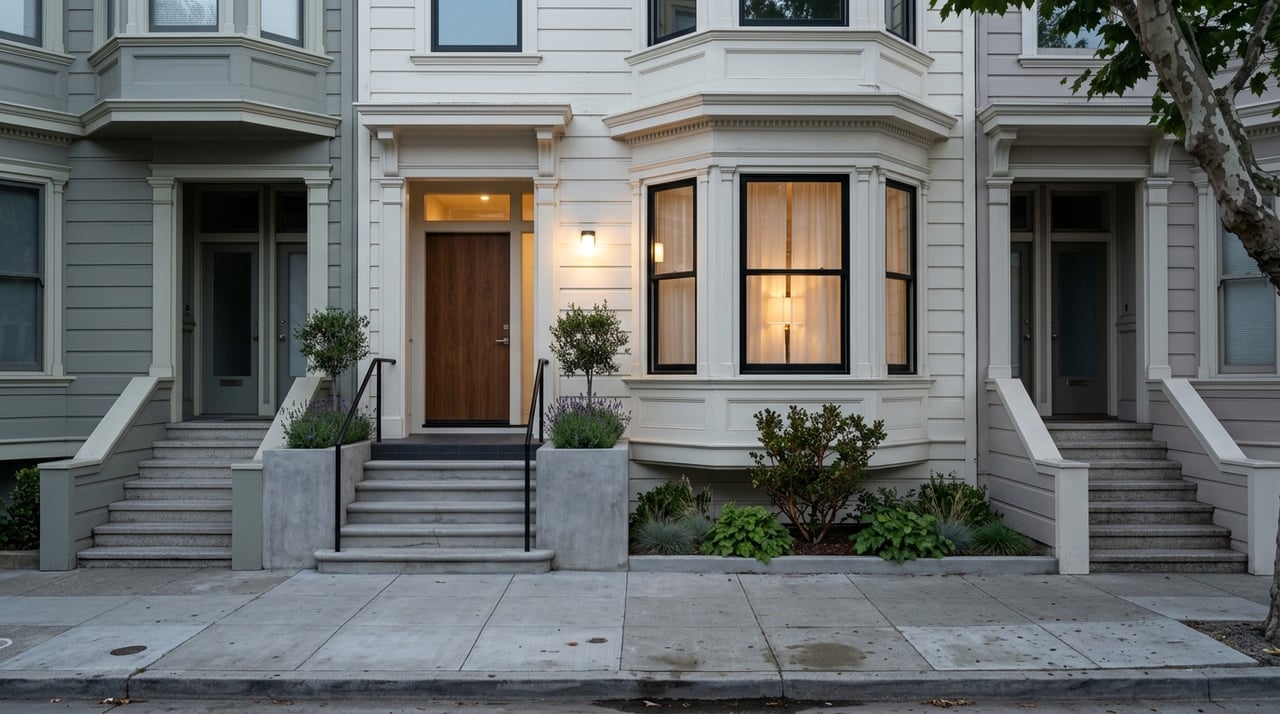
Haight-Ashbury’s built environment remains strongly tied to its late 19th- and early 20th-century roots. San Francisco Heritage describes the neighborhood as an almost entirely intact streetcar suburb developed mainly in the 1890s and early 1900s, dominated by Queen Anne Victorian architecture.
For buyers, that often translates into homes with visual character, period details, and strong architectural identity. Even the commercial blocks reflect this history, with older buildings that help preserve the neighborhood’s recognizable streetscape.
Mixed-use streets are part of the charm
Historic development patterns still shape how the neighborhood works today. San Francisco Heritage notes that early commercial buildings often included flats above storefronts, and San Francisco’s planning code continues to support housing above the ground floor along the Haight Street corridor.
That helps explain why the neighborhood feels so layered. Residential life and commercial activity sit close together, which creates both convenience and a more urban street presence.
What Homes Cost in Haight-Ashbury
Prices remain elevated
Current market indicators point to a neighborhood with consistently high housing values. Redfin reported a March 2026 median sale price of $2.472 million, a median price of about $1,050 per square foot, and an average market time of 8 days.
Other sources show different metrics, but the same general picture. Zillow put the Haight home value index at $1,473,908 as of April 30, 2026, up 7.7% year over year, while Realtor.com reported a March 2026 neighborhood median rent of $3,345 per month and a 94117 median listing price of $1.395 million with median rent of $4,950 per month.
Prices can vary by pocket and property type
One reason Haight-Ashbury can be hard to summarize in a single number is that values vary meaningfully by location and housing type. Nearby Zillow figures show Cole Valley at $1,756,596, the Panhandle at $1,464,045, Buena Vista at $1,794,835, Ashbury Heights at $2,393,940, and Parnassus Heights at $1,945,900.
A practical takeaway is that Haight-Ashbury and its nearby pockets sit roughly in a mid-$1 million to mid-$2 million-plus value band depending on the property and block, with premium locations and larger homes often pushing higher.
Who Haight-Ashbury Tends to Suit
Haight-Ashbury can be a strong fit if you want a neighborhood that feels urban, historic, and highly walkable. It may especially appeal to people who value character homes, easy park access, independent retail, and a daily routine that happens largely on foot.
It may be less ideal if you want a quieter, more uniform residential setting with limited visitor activity. The same elements that make the neighborhood vibrant also mean that some blocks feel busier and more destination-driven than others.
The Real Experience of Living Here
Living in Haight-Ashbury today means balancing energy and ease. You are in a neighborhood with global name recognition, but also one where daily life is grounded in practical routines like grabbing coffee, walking through the Panhandle, hopping on transit, or coming home to a historic flat or house.
That mix is why the neighborhood continues to stand out in San Francisco. It is not frozen in the past, and it is not just a visitor stop. It remains a real residential neighborhood with strong architecture, strong amenities, and a lifestyle that is hard to duplicate elsewhere in the city.
If you are weighing a move in or around Haight-Ashbury, neighborhood nuance matters. From park-adjacent blocks to the busiest stretches of Haight Street, the right fit often comes down to micro-location, property type, and how you want your day-to-day life to feel. To start a confidential conversation about buying or selling in San Francisco, connect with Frank Nolan.
FAQs
What is daily life like in Haight-Ashbury today?
- Daily life in Haight-Ashbury combines a busy commercial corridor, residential side streets, easy park access, and a walk-first routine supported by shops, cafes, and transit.
Is Haight-Ashbury a walkable San Francisco neighborhood?
- Yes. Walk Score gives Haight-Ashbury a 97 Walk Score, which reflects how easy it is to handle many daily errands on foot.
What kinds of homes are common in Haight-Ashbury?
- The neighborhood is known for turn-of-the-century housing, especially Queen Anne Victorian architecture, along with mixed-use buildings that often include housing above storefronts.
How expensive is Haight-Ashbury real estate?
- Market data varies by source and property type, but a useful summary is that home values in and around Haight-Ashbury generally fall in the mid-$1 million to mid-$2 million-plus range, with some premium pockets higher.
Does Haight-Ashbury have good transit access?
- Yes. SFMTA lists multiple transit lines serving the area, giving residents a wide range of options for getting around San Francisco.
What makes Haight-Ashbury different from other San Francisco neighborhoods?
- Haight-Ashbury stands out for its combination of historic architecture, a well-known retail corridor, direct access to the Panhandle and Golden Gate Park, and a neighborhood feel that is both lived-in and visitor-visible.